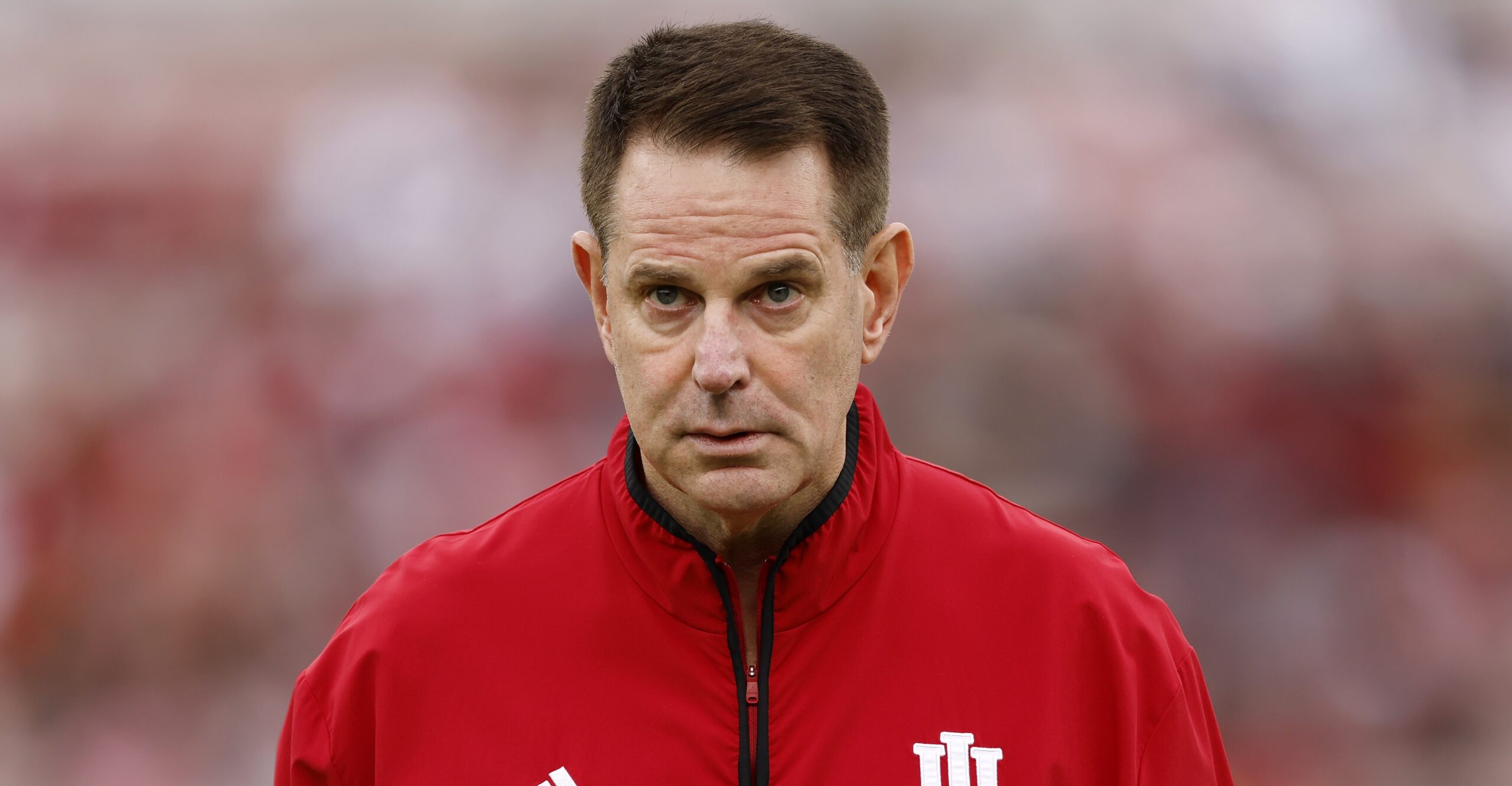
When Curt Cignetti took over as head coach at Indiana, he made a bold declaration: he wins. At his introductory press conference, he stated, “Yeah it”s pretty simple, I win. Google me.” This mantra has become a defining aspect of his tenure, particularly after he turned around a struggling team. In just two seasons, Cignetti transformed a squad that recorded a 3-9 record prior to his arrival into an 11-2 powerhouse in his first year, leading them to the College Football Playoff.
Now, as Indiana prepares to face Miami in the national championship game, Cignetti”s rapid success raises questions about his methods. Central to his strategy was a significant roster overhaul, primarily through the transfer portal. However, unlike many of his contemporaries, Cignetti sought players with proven track records rather than those with untapped potential.
The foundation of his initial transfer class before the 2024 season included 13 players who followed him from James Madison to Indiana. Notably, five of these athletes—Elijah Sarratt, Aiden Fisher, D”Angelo Ponds, Mikail Kamara, and Kaelon Black—made substantial contributions during the 2025 season. Sarratt, a physically imposing receiver, has emerged as a key target for quarterback Fernando Mendoza.
Cignetti”s 2024 transfer class comprised 31 players, emphasizing experienced veterans with solid college performance. Among them were three-star prospects, while Sarratt and quarterback Kurtis Rourke stood out as rare four-star additions. Prominent Indiana alum and supporter, Mark Cuban, recognized Cignetti”s vision early on, noting, “As Cig has said, he wants performance, not potential, which is exactly what he focused on.” Cuban praised the structure Cignetti created, where players understood their roles and a well-prepared coaching staff could quickly develop talent.
The class of 2025 added another 23 players to the roster, including significant transfers like center Pat Coogan, a four-star talent from Notre Dame, and Mendoza. Mendoza, a unique case in college football, began as a three-star recruit who initially committed to Yale before switching to California. After a strong performance as a starter, he was ranked as the fourth-best quarterback in the transfer portal, choosing Indiana and Cignetti with aspirations for further development.
Mendoza expressed the importance of playing for an offensive-minded coaching staff, stating, “To have an offensive-minded coaching staff was extremely important for me and to get that development was really important for me.” He aimed to polish his skills for a potential career in the NFL.
While Mendoza garners significant attention, the emphasis on “production over potential” is evident throughout Indiana”s roster. Fifth-year running backs Roman Hemby and Kaelon Black have handled nearly 80% of the rushing duties, with Hemby previously serving as a lead back at Maryland. The offensive line features transfers like Coogan and Drew Evans, alongside three-star recruits, showcasing a blend of experience and skill.
On the receiving end, Sarratt leads a group that includes E.J. Williams Jr., a transfer from Clemson, and homegrown talents like Charlie Becker and Omar Cooper. The tight end position also benefited from the addition of transfer Riley Nowakowski.
Defensively, the front seven is heavily populated by transfers, including Dominique Ratliff, Tyrique Tucker, Hosea Wheeler, and Mikail Kamara. Only Tyrone Burrus Jr., a freshman, joined as a traditional recruit. Standout linebacker Rolijah Hardy and Isaiah Jones represent some of the limited signees at Indiana, showcasing the balance between transfers and homegrown talent.
The embodiment of Indiana”s roster transformation may well be safety Louis Moore, whose journey included stints at Navarro College and Ole Miss before returning to Bloomington. As he approaches his 25th birthday shortly after the national championship game, Moore exemplifies the experience that characterizes this team.
The result of Cignetti”s strategy is a seasoned roster, with numerous players aged 22 and older. This depth chart is filled with juniors and seniors, contributing to a mature and resilient team. Coogan remarked, “It”s a very veteran group. It”s a mature group. It”s a group that”s been around the block, played a lot of football, and a group that knows how to take (Cignetti”s) messages and put them on the field.”
Hemby added, “I feel like having veterans on the field makes our job easy because we have that sense to where we”ve been through it before. We”re battle-tested. We play for one another. I feel like that really helps us to experience that grit feeling. That helps us to win those games.”
This Indiana team has the potential to challenge the traditional “Blue-Chip Ratio,” a guideline established by Bud Elliott suggesting that to win a national title, a program must recruit more four- and five-star players than two- and three-star athletes over the past four recruiting classes. Indiana”s roster, built on a foundation of experience and performance, may very well redefine this standard.