The Ard-Fheis of the Gaelic League makes its much-anticipated return to Belfast this weekend, occurring from February 20 to February 22. This marks the first time the event has been held in the city since before the Good Friday Agreement. Previously, the Ard-Fheis was only hosted in Belfast once, back in 1932.
The 1996 Ard-Fheis, held at the Europa Hotel, was led by Gearóid Ó Caireallaín, who passed away in December 2024. He was recognized as “the great architect of the modern Irish language revival,” and his legacy will be honored throughout this weekend”s events.
In the last thirty years, Belfast and the surrounding region have witnessed significant advancements in the revival of the Irish language. Currently, there are approximately 8,000 students enrolled in Irish-Medium Schools across over 80 educational settings in the north. This growth is a crucial factor in the flourishing Irish language movement in Belfast, which has gained national and international recognition as a notable example of grassroots indigenous language reclamation, rooted in the efforts of the pioneers from Bóthar Seoighe.
In recent years, Belfast has made considerable progress in promoting the Irish language through initiatives led by the Belfast City Council. In 2018, the Council approved its first Language Strategy, which included the appointment of the city”s inaugural full-time Irish Language Officer. A new Dual-Language Street Signage Policy, inspired by best practices from the United Nations, has resulted in a remarkable increase in dual-language signs across 600 streets since October 2022. This policy has reinstated many indigenous place names that had previously been excluded from public spaces, with an estimated 1,000 more applications pending for future signage.
Last year, Belfast City Council ratified a historic Irish Language Policy that laid out a comprehensive framework for dual-language signage and services in Council facilities. Although this policy has faced a temporary pause due to legal actions concerning council standing orders, £1.9 million has been allocated to support its implementation in the coming year.
The advancements in language rights and resources have positioned Belfast to host major national cultural events. This past Halloween, Oireachtas na Samhna brought around 15,000 visitors to the city, paving the way for an anticipated influx of approximately 800,000 attendees at Fleadh Cheoil na hÉireann this summer. Additionally, the city will welcome an international conference of experts on minoritized languages in November.
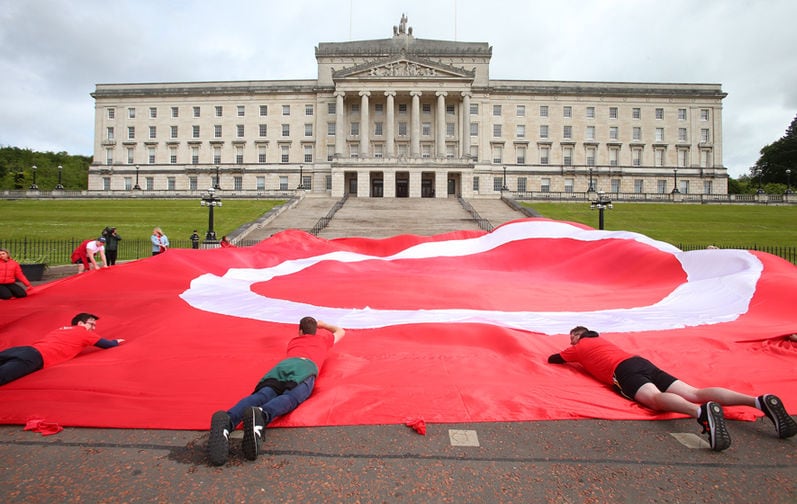
This revitalization of language and culture coincides with the enactment of the 2022 Language Act and the recent appointment of the Irish Language Commissioner. The functions and powers granted by this legislation commenced just weeks ago, heralding a new chapter of language rights and policies across public authorities. This development follows decades of activism that mobilized An Dream Dearg, bringing 20,000 people to City Hall for An Lá Dearg in 2022.
The keynote address at the Ard-Fheis will be delivered by the new Irish Language Commissioner, Dr. Pól Deeds, on Friday, February 20, at the Europa Hotel. This address will lead into a panel discussion exploring the significance of the Irish language in a potential United Ireland. On Saturday morning, delegates and branches of Conradh na Gaeilge will gather to discuss and vote on approximately 60 motions addressing issues ranging from housing rights in the Gaeltacht to educational reforms and language rights across both Northern Ireland and the Republic.
Among the motions, a historic proposal to amend the constitution of Conradh na Gaeilge to advocate for a United Ireland to benefit the Irish language and the Gaeltacht will be on the agenda. This moment is poised to be a significant turning point for the organization that will resonate for future generations. The events over the weekend are set to echo well beyond the confines of the Europa Hotel, marking a pivotal moment as Conradh na Gaeilge charts a new course for the Irish language and the Gaeltacht in conjunction with the future of the island.