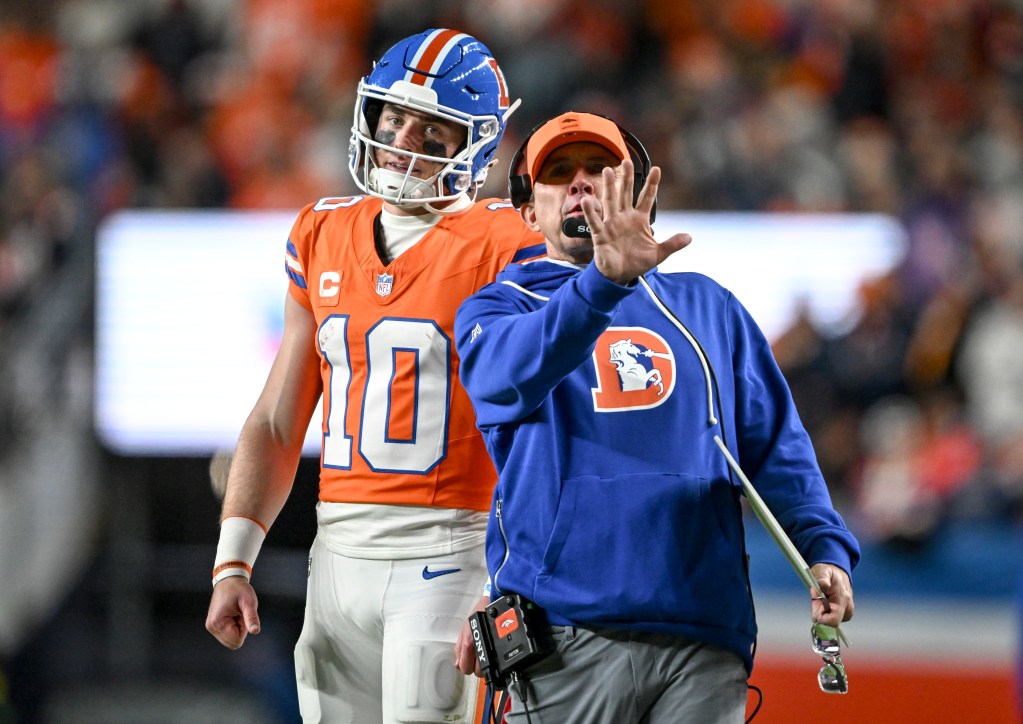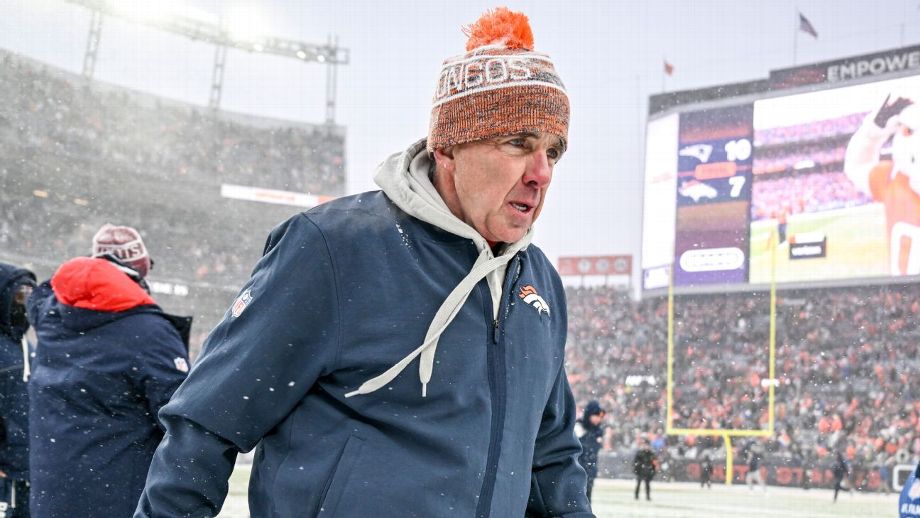
Last Sunday night, Sean Payton found himself in his office at the Denver Broncos facility, analyzing film of the upcoming AFC Championship game against the New England Patriots. In the background, he had the Los Angeles Rams and Chicago Bears divisional round game playing. As he flipped through channels, he accidentally landed on a children”s program before finally tuning in just in time to see the Bears face a pivotal fourth-down decision. With fourth-and-two at the Rams” 21-yard line, Chicago opted to forgo an easy field goal attempt and instead went for the conversion. The result was an interception thrown by Caleb Williams, which cost the Bears three crucial points, a margin that proved significant in the final score.
As Payton observed the decision unfold, he voiced his frustration, asking, “Why are coaches not kicking field goals?” This dilemma around whether to take the points or go for it on fourth-and-short has become a hot topic in football, sparking debates among fans and analysts alike. Historically, most coaches would have taken the points without question, but this strategy has shifted since the early 2000s. A pivotal moment came in 2002 when economist David Romer published a paper that used mathematical principles to advocate for more aggressive fourth-down decisions, suggesting that the potential rewards of a successful conversion often outweighed the risks of kicking or punting.
In recent years, coaches have increasingly embraced this aggressive approach. Evan Rothstein, the Broncos” director of game management, is a key advisor to Payton, bringing insights from his time with the Detroit Lions and New England Patriots, where he learned under legendary coach Bill Belichick. During the season, Rothstein provides detailed presentations to Payton and the coaching staff, analyzing key moments from previous games and offering data-driven strategies for similar situations.
Despite the analytics at play, the ultimate decision rests with Payton. Typically, when the Broncos are moving down the field and face a fourth-and-short situation, they lean towards going for it. However, the context of the AFC Championship game added significant pressure. With quarterback Jarrett Stidham making his first start after Bo Nix suffered an injury, and the defense struggling in recent weeks, the stakes were high. The Broncos had narrowly escaped elimination in the divisional round due to their ineffective red zone offense.
In the second quarter against the Patriots, the Broncos led 7-0 and advanced into the red zone. After a five-yard scramble by Stidham left them with a fourth-and-one, Payton faced another critical decision. He expressed his desire for a 14-0 lead and opted to go for it, calling for a running play known as Nickel Duo, intending to exploit their advantage. However, after calling a timeout to reconsider, he ultimately chose to pass, but the Patriots countered with a surprise defensive setup that rendered the play ineffective. Stidham”s pass fell incomplete, costing the Broncos not just the chance at three points but also their best opportunity to score.
Reflecting on the decision after the game, Payton lamented, “I wish I”d stayed with the initial play call.” The defense played well, but several factors led to the Broncos” defeat. In addition to missing two field goals, Stidham”s fumble resulted in a touchdown for the Patriots, and he later threw an interception that sealed the game. The Broncos” defense, despite performing admirably, failed to create any turnovers.
As the echoes of defeat lingered, Payton sat alone in his office, grappling with the loss. With decades of coaching experience and a Super Bowl victory to his name, he reflected on the missed opportunities, admitting, “I can”t believe we lost.” His thoughts returned to that pivotal fourth down, encapsulating the unpredictability and pressure inherent in coaching decisions at this level.